

Cloud Migration Tools Portfolio
Discovery, Assessment, VMs, Databases, Applications & Kubernetes AWS • Microsoft Azure • Google Cloud • Cross-platform options
| Scope | Discovery & assessment; VM rehost; database migration; application modernization; AKS to EKS |
|---|---|
| Primary AWS paths | AWS Transform, MGN, DMS + Schema Conversion, Velero + EKS platform services |
| Audience | Migration architects, platform engineers, programme managers, FinOps and cloud centers of excellence |
| Status baseline | Late 2026 — confirm lifecycle and Region availability with the provider before scoping |
1. Introduction and Scope
Successful cloud migration programmes combine discovery, assessment, wave planning, data movement, and cutover. No single product covers every workload type across every cloud. This white paper consolidates the current tool landscape for:
- Infrastructure and application discovery and assessment
- Virtual machine and server rehost (lift-and-shift)
- Database assessment, schema conversion, full load and CDC
- Application modernization (rehost, replatform, containerize, refactor)
- Kubernetes workload migration from Azure Kubernetes Service (AKS) to Amazon Elastic Kubernetes Service (EKS)
Tools are described with status flags (Available, Preview, Closed to new customers, Ended/Retired). For new programmes, prefer the current primary path on each cloud and treat closed or ended products as in-flight-only.
1.1 Status Snapshot — Do Not Start New Projects On
- AWS Migration Hub — closed to new customers since 7 November 2025
- AWS App2Container, Porting Assistant for .NET, Toolkit for .NET Refactoring, Microservice Extractor for .NET — closed to new customers 7 November 2025
- AWS DMS Fleet Advisor — ended 20 May 2026; use AWS Migration Evaluator
- Azure classic replication appliance — retired 30 September 2026; use the simplified appliance
- Movere (Azure) — retired
1.2 Primary AWS Paths for New Programmes
- Discovery, planning, application modernization: AWS Transform VM rehost: AWS Application Migration Service (MGN)
- Databases: AWS DMS + DMS Schema Conversion (AWS SCT for warehouses and wider sources)
- AKS → EKS: Velero (File System Backup for volumes) + declarative/GitOps redeployment + ECR, Pod Identity, EBS CSI
- TCO and licensing: AWS Migration Evaluator and AWS Optimization and Licensing Assessment (OLA)
- AWS Migration Hub — closed to new customers since 7 November 2025
- AWS App2Container, Porting Assistant for .NET, Toolkit for .NET Refactoring, Microservice Extractor for .NET — closed to new customers 7 November 2025
- AWS DMS Fleet Advisor — ended 20 May 2026; use AWS Migration Evaluator
- Azure classic replication appliance — retired 30 September 2026; use the simplified appliance
- Movere (Azure) — retired
- Discovery, planning, application modernization: AWS Transform
VM rehost: AWS Application Migration Service (MGN) - Databases: AWS DMS + DMS Schema Conversion (AWS SCT for warehouses and wider sources)
- AKS → EKS: Velero (File System Backup for volumes) + declarative/GitOps redeployment + ECR, Pod Identity, EBS CSI
- TCO and licensing: AWS Migration Evaluator and AWS Optimization and Licensing Assessment (OLA)
2. Portfolio Framework
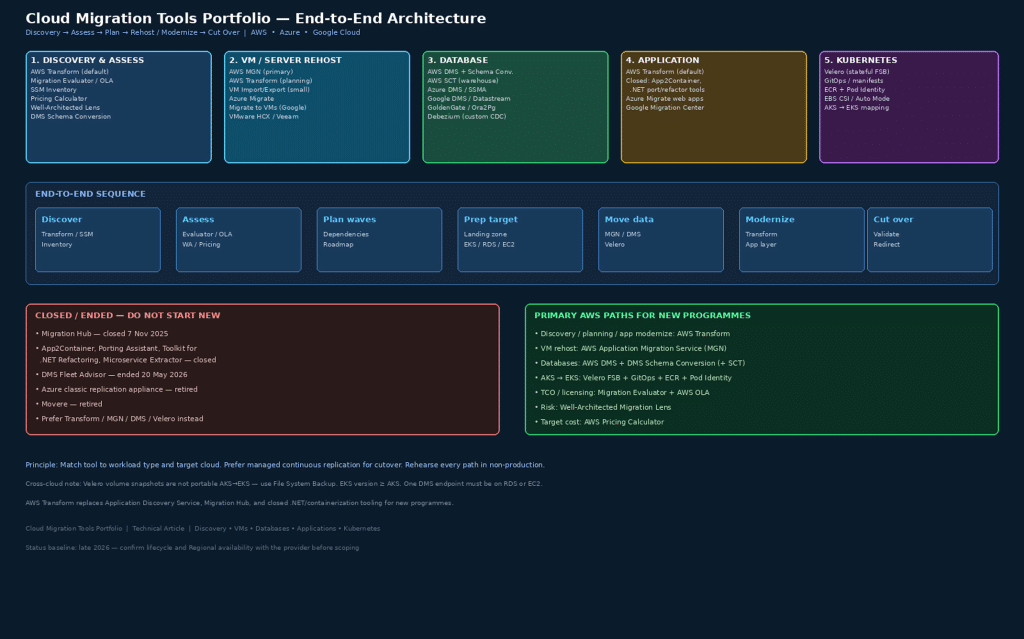
The diagram below maps the five workload domains, the end-to-end sequence from discovery to cutover, closed tools, and the recommended AWS starting points.
3. Discovery and Assessment
Discovery and assessment establish inventory, dependencies, right-sizing, licensing, cost and risk before any cutover. AWS Transform is the recommended default for new programmes, replacing Application Discovery Service and Migration Hub for greenfield work.
3.1 AWS Discovery Tools
| Tool | Status | Role |
|---|---|---|
| AWS Transform | Available | Agentic discovery (OVA for vCenter/Hyper-V), dependencies, wave planning, PDF business case; exports MPA for assessment (up to 30,000 servers) |
| Systems Manager Inventory | Available | Metadata from SSM-managed nodes (apps, network, updates, services); Athena-queryable; no dependency graph |
3.2 AWS Assessment Tools
| Tool | Status | Role |
|---|---|---|
| AWS Migration Evaluator | Available | Directional TCO; Quick Insights and expert-led Business Case; collector or uploaded inventory; VMware and Hyper-V (not Citrix XenServer) |
| AWS OLA | Available | Complimentary licence and right-sizing assessment, especially Microsoft workloads; ~45-day process via AWS or Partner |
| AWS Pricing Calculator | Available | Target-state cost estimates; workload and bill imports; discounts and commitments in-console |
| Well-Architected Tool | Available | Migration Lens: assess, mobilize, migrate for rehost/relocate/replatform/retire; risk list and improvement plan |
| DMS Schema Conversion | Available | Schema and code conversion assessment to Aurora/RDS; GenAI assistance on selected paths |
3.3 Discovery-to-Roadmap Process
A practical seven-stage workflow:
- Infrastructure discovery — scope, deploy collectors, full business cycle of utilization
- Server inventory — consolidate, de-duplicate, validate with CMDB and owners
- Dependency mapping — network connections, application groups
- Compatibility assessment — OS, database, licensing, schema conversion effort
- Cost estimation — right-size, licence scenarios, target AWS cost
- Risk analysis — Migration Lens, likelihood and impact
- Migration planning — waves, strategy, cutover windows, roadmap
4. Virtual Machine and Server Migration
Rehost (lift-and-shift) remains the default for large estates where application change is deferred. Continuous block-level replication minimises cutover windows.
4.1 AWS
| Tool | Status | Role |
|---|---|---|
| AWS Application Migration Service (MGN) | Available | Primary rehost path: continuous block-level replication from physical, virtual and cloud servers to EC2; applications & waves; cutover typically minutes. Agent required. Rehost only. |
| AWS Transform (migrations) | Available | Agentic discovery, TCO, dependency waves, landing zone/network conversion, rehost orchestration. Preferred for large VMware/Hyper-V/bare-metal programmes |
| AWS VM Import/Export | Available | One-time OVA/VMDK/VHD/raw import as AMI or instance. Small numbers and golden images. Not continuous; P2V and ARM64 unsupported; 32-bit imports stopped 1 Apr 2026. |
| AWS Migration Hub | Closed to new customers | Tracking only. Closed 7 Nov 2025; use Transform for new programmes. |
4.2 Azure and Google Cloud (summary)
Azure: Azure Migrate as hub; agentless VMware replication (up to 500 simultaneous); agent-based for Hyper-V, physical and other clouds via simplified appliance; Site Recovery for DR..
Google Cloud: Migrate to Virtual Machines (free, continuous replication to Compute Engine from vSphere/AWS/Azure/GCVE); Migration Center for TCO and planning; VMware HCX for GCVE unchanged.
4.3 Scenario Quick Reference — VMs
| Scenario | Recommended path |
|---|---|
| VMware → AWS | Transform for planning; MGN for replication |
| VMware → Azure | Azure Migrate agentless (simplified appliance) |
| VMware → Google (Compute Engine) | Migrate to Virtual Machines |
| Hyper-V / physical → AWS | VMware HCX |
| Hyper-V / physical → Azure | MGN |
| Few VMs / golden images → AWS | Azure Migrate agent-based |
| Few VMs / golden images → AWS | VM Import/Export |
5. Database Migration
Database work splits into assessment, schema/code conversion, full load, and change data capture (CDC). One endpoint for AWS DMS must be on Amazon RDS or EC2 (on-premises to on-premises is not supported).
5.1 AWS
| Tool | Status | Role / limits |
|---|---|---|
| AWS DMS | Available | Full load, CDC, continuous replication; DMS Serverless auto-scales. Homogeneous and heterogeneous into RDS, Aurora, Redshift and others. Guideline: relational under ~10 TB. |
| DMS Schema Conversion | Available | Oracle PL/SQL and SQL Server T-SQL to RDS/Aurora MySQL or PostgreSQL; GenAI (Bedrock) for selected sources to Aurora/RDS PostgreSQL. Free apart from storage. |
| AWS SCT | Available | Downloadable; OLTP and data warehouse schemas, ETL, embedded SQL; strong for Redshift and sources outside Schema Conversion. Confirm lifecycle with AWS. |
| DMS Fleet Advisor | Ended | Ended 20 May 2026. Use Migration Evaluator for assessment. |
5.2 Cross-Cloud and Third-Party (summary)
Azure: Azure Migrate for assessment; Azure DMS for SQL Server and MySQL; SSMA for heterogeneous to SQL family; dedicated PostgreSQL migration service to flexible server.
Google Cloud: Database Migration Service (homogeneous and heterogeneous with conversion workspaces); Datastream for CDC to BigQuery/Iceberg/GCS (not cutover).
Third-party: Oracle GoldenGate (low-downtime Oracle); Ora2Pg (open-source Oracle→PostgreSQL); Debezium (custom CDC); mysqldump/MyDumper for small offline MySQL.
5.3 Scenario Quick Reference — Databases
| Scenario | Recommended path |
|---|---|
| Oracle → PostgreSQL on AWS | DMS Schema Conversion (GenAI available), then AWS DMS |
| SQL Server → AWS | AWS DMS; Schema Conversion if changing engine |
| SQL Server → Azure | Azure Migrate assess; Azure DMS online to SQL MI or SQL on VM |
| PostgreSQL → Azure | Migration Service for Azure Database for PostgreSQL |
| Oracle/SQL Server → Google PostgreSQL | Google DMS heterogeneous + conversion workspaces |
| CDC to analytics (not cutover) | Datastream (Google) or Debezium (custom) |
6. Application Migration and Modernization
AWS Transform is the single AWS path for new application modernization. Standalone .NET and containerization tools are closed to new customers.
6.1 AWS
| Tool | Status | Role |
|---|---|---|
| AWS Transform | Available | Agents for mainframe, .NET/Windows, VMware, custom code (Java, Node.js, Python); continuous modernization in preview |
| App2Container / Porting Assistant / Toolkit for .NET Refactoring / Microservice Extractor | Closed to new customers | Finish in-flight only; security updates, no new features. Use AWS Transform for new work. |
6.2 Azure and Google Cloud (summary)
Azure: Azure Migrate web app assessment (App Service vs AKS); agentless ASP.NET migration from VMware to App Service; App Service Migration Assistant for individual .NET/PHP sites; Copilot migration agent (preview) for planning only.
Google Cloud: Migration Center for TCO, dependencies, technical fit and strategy (rehost/replatform/refactor); confirm container migration tooling before scoping.
7. Kubernetes: AKS to EKS Migration
There is no single managed AKS-to-EKS service. Migration combines backup/restore (Velero), image copy, manifest or GitOps redeployment, and EKS platform services. Map AKS dependencies to EKS equivalents before restore.
7.1 Critical Constraints
- Velero cannot migrate volume snapshots across cloud providers — use File System Backup or the CSI snapshot data mover.
- Velero does not support restore into a lower Kubernetes version than the source — create EKS at the same or newer version than AKS.
- EKS version lifecycle: prefer a version in standard support (e.g. 1.35+); extended support incurs extra per-cluster-hour charge. Newest EKS version referenced: 1.37 (1 Oct 2026).
- EKS Pod Identity is not supported on Fargate or Windows EC2 — use IRSA or Linux EC2 for those workloads.
7.2 Component Mapping
| AKS component | EKS equivalent | Migration note |
|---|---|---|
| Azure Container Registry | Amazon ECR | Copy images; update references |
| Entra Workload ID | EKS Pod Identity or IRSA | Recreate IAM role ↔ service account |
| Azure Key Vault | AWS Secrets Manager | Move secrets; update consumers |
| Defender for Containers | Amazon GuardDuty | Re-enable threat detection |
| Azure CNI options | Amazon VPC CNI (default) | Review addressing and policies |
| Azure Disk / Files CSI | EBS / EFS CSI | Storage class mapping in Velero |
| Azure LB annotations | ALB / NLB | Auto Mode or annotations update |
7.3 Migration Tools and Platform Services
- Velero — primary path for namespaces and stateful data via File System Backup; same backup location readable by destination cluster.
- Declarative redeployment (manifests, Helm, GitOps) — preferred for stateless workloads after replacing Azure-specific settings.
- Amazon EKS / EKS Auto Mode — managed control plane; Auto Mode can own compute, EBS CSI, ALB/NLB, networking and DNS.
- EKS Pod Identity — replace Entra Workload ID (Linux EC2 only).
Amazon EBS CSI driver — target for restored persistent volumes.
7.4 Recommended AKS → EKS Sequence
- Prepare EKS at same or newer Kubernetes version; install EBS CSI and Pod Identity (or use Auto Mode).
- Copy images from ACR to ECR; update image references.
- Map identity and secrets (Workload ID → IAM roles; Key Vault → Secrets Manager).
- Redeploy stateless workloads from updated manifests or GitOps.
- Move stateful data with Velero File System Backup and storage class mapping.
- Validate on EKS, then redirect traffic (load balancers, DNS).
8. Cross-Domain Tool Comparison Summary
| Domain | EKS equivalent | Method | Best fit |
|---|---|---|---|
| Discovery / assess | AWS Transform + Evaluator/OLA | Collectors, MPA, TCO | New programmers |
| VM rehost | MGN (+ Transform planning) | Block-level continuous replication | Scale rehost to EC2 |
| Database | DMS + Schema Conversion | Full load + CDC; code convert | Into RDS/Aurora/Redshift |
| Application | AWS Transform | Agentic assess/transform/deploy | Mainframe, .NET, VMware, code upgrades |
| AKS → EKS stateful | Velero File System Backup | Backup/restore + storage map | Namespaces with PVs |
| AKS → EKS stateless | GitOps / manifests | Redeploy after remap | Clean rebuild on EKS |
9. Conclusion and Recommendations
Treat migration tooling as a portfolio matched to workload type and target cloud—not a single product. For new AWS programmes:
- Start discovery and modernization with AWS Transform.
- Rehost servers with AWS Application Migration Service (MGN), with Transform for large-scale planning.
- Move databases with AWS DMS and DMS Schema Conversion; use AWS SCT where warehouse or broader source coverage is required.
- Migrate AKS workloads with Velero (File System Backup for volumes), declarative redeployment for stateless layers, and full mapping of identity, secrets, storage classes and load balancers to EKS services.
- Ground cost and licence decisions in Migration Evaluator and OLA; validate architecture risks with the Well-Architected Migration Lens.